
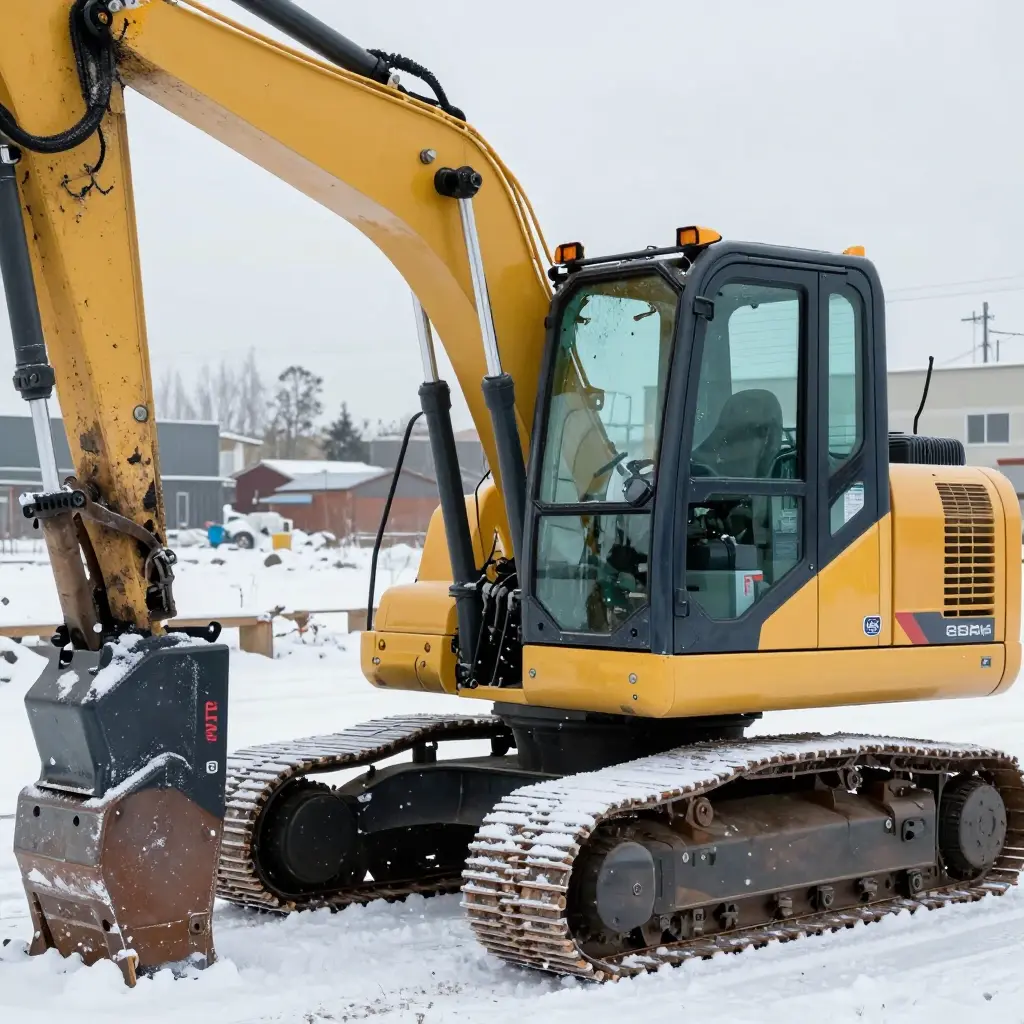
Below freezing, a lithium-ion pack doesn’t just deliver less energy. Its whole operating envelope changes. The thermal management system that coasts along in mild weather becomes the hungriest subsystem on the machine, and for any electric excavator battery, cold-weather performance comes down to three things: cell chemistry, internal resistance, and how much heat the pack has to make for itself.
Cell Chemistry Limits Below Freezing
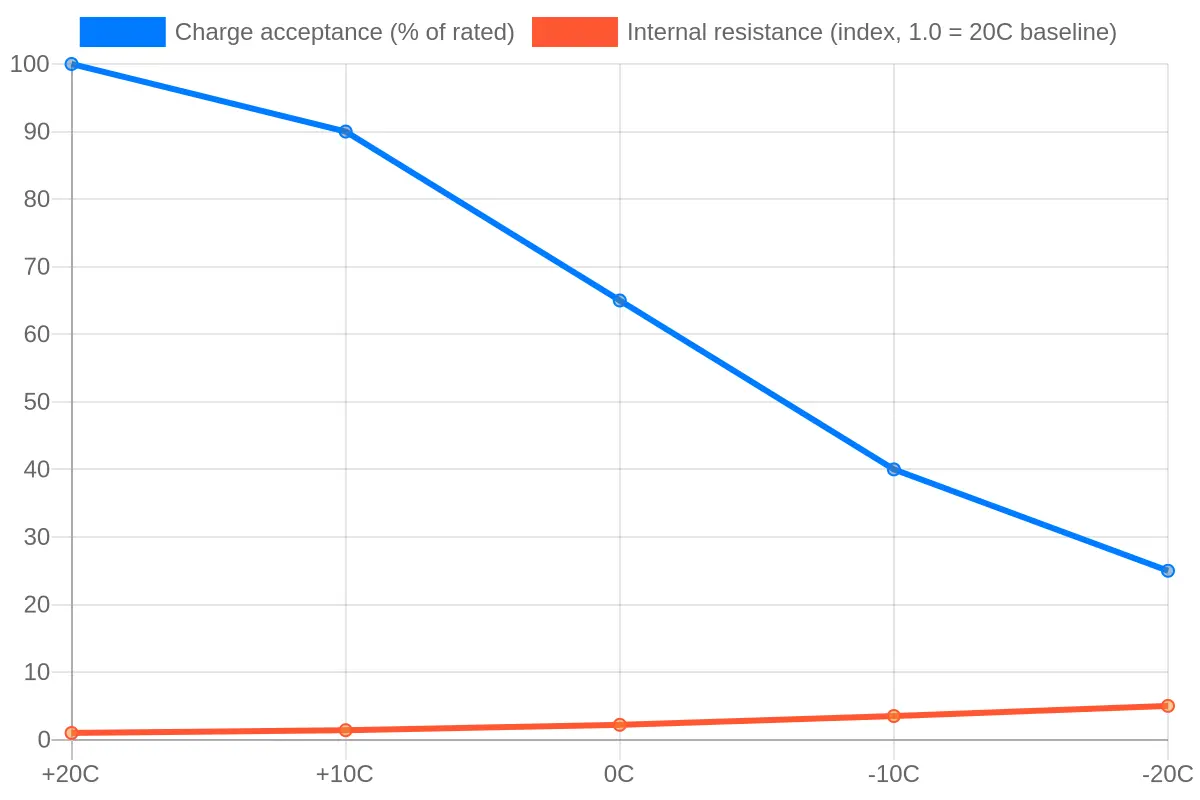
A lithium-ion cell moves lithium ions between its electrodes through a liquid electrolyte. As the temperature drops toward 0°C, that electrolyte thickens and the ions move more slowly, so usable capacity shrinks. Charging is the sharper hazard. Below freezing, lithium ions can plate onto the anode as metallic lithium instead of intercalating into the graphite, and that plating is irreversible: it permanently costs capacity and raises safety risk. That is why most battery management systems block charging below roughly 0°C, or allow only a trickle, until the pack warms.
Rising Internal Resistance
Cold electrolyte and slower kinetics push internal resistance up, often to three or five times its room-temperature value near -20°C. Higher resistance means deeper voltage sag under load, so the pack can read full while delivering less power. Hydraulics and traction feel sluggish, and state-of-charge estimates that rely on voltage get less reliable.
Reduced Charge Acceptance
With resistance high and plating a real risk, the current the pack can safely absorb collapses. Regenerative braking, one of the biggest efficiency wins in warm conditions, is heavily restricted or switched off, and fast charging is deferred until the cells reach a safe temperature window. A thermal design that looks healthy on paper can hide a genuine cold-weather deficit here.
The Energy Cost of Active Heating
Liquid-cooled packs can also heat cells, but the heat is not free. Resistive heaters, and in some designs heat pumps or loops that scavenge motor waste heat, draw from the pack they are warming. On a cold start, a meaningful share of stored energy goes into bringing the cells up to temperature before the machine digs anything, which cuts runtime and eats into the fuel savings the machine was bought for.
How BTM Systems Allocate Power
The controller is always balancing two demands: keeping the cells inside their safe temperature window, and keeping power flowing to the machine. Good priority logic warms the pack during low-load moments and preheat windows, caps discharge current when cells are cold, and blends heater duty with traction demand. Tune it badly and you either starve the machine of power or drain the pack into the heater. Both hurt the economics of electrification.
In cold weather, thermal management decides whether an electric machine is a fuel-saving asset or an expensive liability.
Cold-Weather Effect: Range Fades as Thermal Draw Climbs
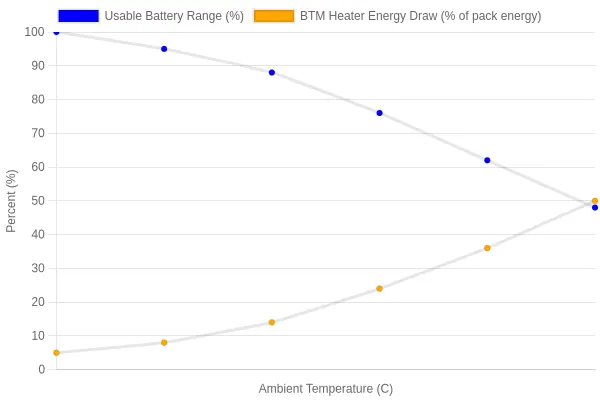
Figure: As ambient temperature falls from 20°C to -30°C, usable battery range collapses while the battery thermal management (BTM) system consumes a growing share of stored pack energy.
| Ambient Temp (°C) | Usable Battery Range (%) | BTM Heater Draw (% of pack energy) |
|---|---|---|
| 20 | 100 | 5 |
| 10 | 95 | 8 |
| 0 | 88 | 14 |
| -10 | 76 | 24 |
| -20 | 62 | 36 |
| -30 | 48 | 50 |
Examining the Fuel-Savings Proposition
The fuel savings from swapping diesel for electric are real, but they get oversold when someone quotes a single hourly number and stops there. A mid-size diesel excavator in the 20-ton class burns roughly 3 to 5 gallons per hour. At an off-road diesel price near $4 per gallon, that is $12 to $20 in fuel every operating hour. The battery-electric equivalent draws roughly 20 to 35 kWh per hour; at a commercial rate of $0.13 per kWh, that is $2.60 to $4.55. So the gross fuel savings land between $10 and $16 per operating hour, before any thermal-management load is added.
Maintenance widens the gap a little. Diesel machines need engine oil, fuel filters, DEF, and exhaust-aftertreatment service that electric drivetrains largely eliminate, and across a full service life that is worth roughly $2 to $5 per operating hour. Add it up and the headline claim is $12 to $21 of avoided cost per hour, in temperate conditions.
Where Cold-Weather Realities Erode the Case
Cold weather changes the arithmetic in three ways:
- Reduced runtime. In cold weather, usable battery capacity falls by 20 to 40 percent, so a pack sized for a 10-hour shift may deliver only 6 to 8 productive hours.
- Added heating energy. Warming the cab and, more importantly, holding the pack at temperature can draw 3 to 8 kW continuously, adding roughly $0.40 to $1.05 per hour back onto operating cost.
- Slower cycle times. Colder hydraulic fluid and power derating stretch cycle times by 10 to 20 percent, so each productive hour moves less material.
That distortion matters for total cost of ownership. The fuel-savings case assumes a fixed number of productive hours. When runtime shrinks and cycle times stretch, the savings per cubic yard moved can fall by a third or more. A pack rated for a full shift may, in sustained sub-freezing work, move fewer tons per charge than its nameplate suggests, and the shortfall lands directly on the cost-per-unit-of-work figure that decides whether the machine pays.
The table below sets the promised fuel savings against the real cost of common cold-weather thermal failures.
| Failure/Event | Cause | Typical Downtime | Repair or Replacement Cost Range | Net Impact vs. Fuel Savings |
|---|---|---|---|---|
| Reduced winter range | Cold slows cell chemistry, trims usable charge | 0-1 days (lower output) | No direct cost; 20-40% range loss | Erodes most seasonal fuel savings |
| Premature capacity fade | Repeated sub-freezing charging and deep cycling | Weeks spread over service life | $15,000-$60,000 (partial pack) | Exceeds 2-4 years of fuel savings |
| Heater system failure | Coolant leak, element burnout, controller fault | 2-7 days | $1,200-$8,000 | Erases roughly one season of savings |
| Cell imbalance | Uneven heating, weak cells in cold strings | 1-5 days | $500-$4,000 (module or balancing) | Offsets several months of savings |
| Emergency charging / diesel backup | Grid limits, blocked charging, standby genset | Recurring per event | $300-$2,500 per incident | Adds cost instead of saving |
A single winter failure can consume a year of fuel savings, which is why the reliable part of the system, thermal management, matters more to ownership cost than the price of diesel.
Cold-Weather Battery Thermal Management Failure Modes
In cold weather, thermal management failures rarely show up as a warning light. They show up as slow charging, sagging power, and a machine that quits mid-shift. For equipment managers, knowing where the system tends to break is the first step to protecting runtime and battery life.
- Reduced charge acceptance: When temperatures drop, lithium-ion cells resist incoming current, so packs charge slowly or reject energy outright until they warm up. That stretches charging windows and quietly eats into shift productivity.
- Elevated internal resistance: Cold thickens the electrolyte and slows ion movement, spiking resistance across the pack. The result is more wasted heat, lower usable voltage, and noticeably weaker breakout and lift performance.
- Thermal runaway risk during fast charging: To recover lost time, operators often demand high charge rates, but cold cells cannot safely absorb that current. Lithium plating and localized hotspots can form, and in the worst cases escalate toward thermal runaway.
- Coolant freezing or viscosity issues: A water-glycol loop can gel, thicken, or freeze, stalling circulation through the cold plates. With no flow, the pack loses its main means of shedding or adding heat.
- Uneven cell heating: Heaters and coolant channels often warm a pack unevenly, leaving some modules frigid while others run hot. Mismatched cells age faster and drag down overall pack life.
- Heater drain on range: Cabin and pack heaters draw straight from the battery, so energy budgeted for digging gets spent on warming instead. Range and runtime shrink exactly when the workload is heaviest.
- Sensor or control faults: Condensation, ice, and brittle wiring can corrupt the temperature and voltage readings sent to the BMS. A confused controller may refuse to charge or misjudge state of charge, triggering nuisance faults.
How a Liquid-Cooled Battery Thermal Management Loop Works
The schematic below traces the closed coolant circuit that holds an electric excavator’s battery pack inside its safe operating window, the same loop that separates a machine still digging at -20°C from one stalled on the site.
Follow it clockwise: the pump pushes coolant through channels in the battery pack, where it absorbs heat from the cells in cooling mode or gives up heat to warm them in heating mode. From there the coolant reaches the combined heater/chiller unit, which adds or removes thermal energy, then the heat exchanger, which rejects or recovers heat against outside air. Arrows trace the flow, and red and blue coding mark heated versus cooled coolant, so the heating-versus-cooling logic is clear at a glance.
The Cost Asymmetry: Why One Thermal Failure Outweighs a Year of Fuel Savings
The cold-weather economics of electric excavators are usually presented as a simple fuel equation: eliminate diesel, capture steady savings, and let the numbers compound quietly over time. That framing is misleading because it sets a slow, predictable gain against a fast, unpredictable loss. The two do not carry the same risk, and they should not be weighed as if they did.
Fuel savings arrive gradually. A mid-size electric excavator might save roughly 1,500 USD per month in avoided diesel and fluid costs, reaching about 18,000 USD over a full year. That figure is linear, forecastable, and easy to bank.
Thermal failures go the other way. In cold conditions, reduced cell capacity, uneven heating, and charging stress can push a pack past the point of recovery. The loss is not gradual; it is a step change triggered by a single event.
What a Single Failure Actually Costs
The headline expense is a battery replacement, which on a large machine pack can reach tens of thousands of dollars and is rarely a line item most operators have budgeted. But replacement is only the entry point. The compounding costs arrive afterward:
| Cost Category | Representative Impact |
|---|---|
| Battery replacement | 40,000-60,000 USD per pack |
| Downtime | 1,000-2,500 USD per hour of idle crew and equipment |
| Emergency rental | Premium daily rates plus mobilization |
| Lost productivity | Schedule slippage and penalty clauses |
| Safety remediation | Inspection, isolation, and documentation |
| Warranty implications | Voided coverage for abuse or improper charging |
Downtime cost per hour is the multiplier that makes the asymmetry brutal. A failure that sidelines a machine for even two days can erase an entire year of fuel savings before anyone orders a replacement part.
Warranty makes it worse. Many manufacturers treat a thermal event as evidence of misuse or inadequate charging practice, which can void coverage and shift the full burden onto the owner, turning a warranty claim into a capital loss.
What the Comparison Actually Says
The comparison is not fuel savings versus a battery replacement. It is a predictable annual gain against a sudden, compounding, largely uninsured loss that also threatens warranty protection. For fleet managers evaluating electric excavators in cold weather, the deciding figure is not the yearly fuel number but the exposure that thermal failures create. Mitigating that risk through insulation, preheating, and disciplined charging is not an operational nicety; it is the difference between an asset that pays and one that sits dead on site.
Best Practices for Preserving Cold-Weather Battery Health
Cold temperatures slow the chemical reactions inside lithium-ion cells, cutting usable capacity and raising internal resistance. For equipment managers running electric excavators through winter, a few disciplined habits keep the electric excavator battery healthy and predictable.
- Pre-condition packs before each shift. Warming the electric excavator battery to its optimal operating window before the first dig prevents power derating and shields cells from the mechanical strain that cold weather performance otherwise forces on them at startup.
- Schedule charging to leverage warmer periods. Charge mid-shift or midday when ambient temperatures peak, so the pack accepts energy faster and the risk of lithium plating that shortens pack life stays low.
- Use insulated enclosures or heated storage. Parking equipment in heated bays or wrapping batteries in thermal blankets slows overnight temperature drop, keeping cold weather performance stable and avoiding a sluggish morning start.
- Monitor state of health and cell balance. Track SOH trends and per-cell voltages to catch imbalance early, since cold weather amplifies divergence between strong and weak cells and can mask developing faults.
- Set conservative charge and discharge limits. Cap charging at a moderate state of charge and limit discharge current to reduce stress on a chilled electric excavator battery and extend its service life.
- Plan winter capacity margins. Budget 20-30% extra runtime or charging windows so reduced cold weather performance never stalls production schedules or strands machines on site.
The Cold-Weather Deployment Decision Flow
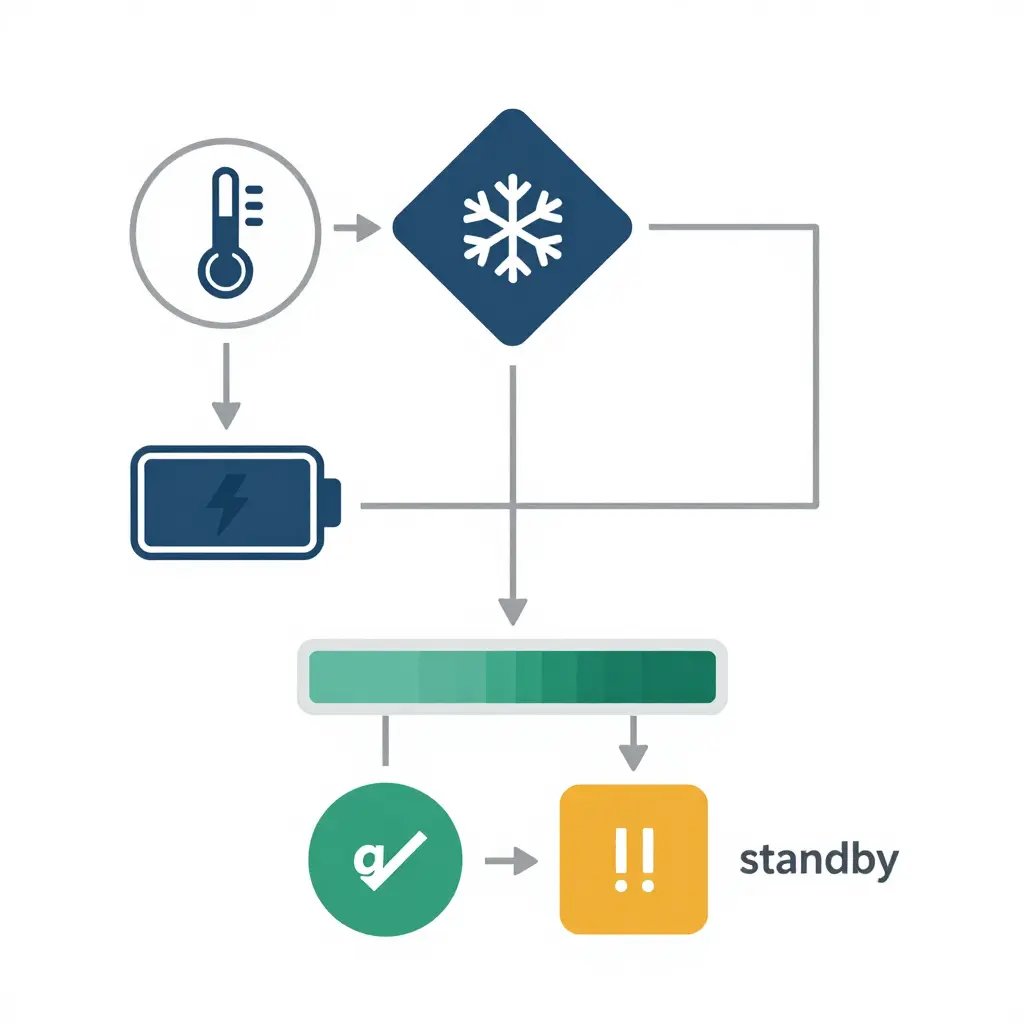
Before an electric excavator rolls onto a frozen site, run a quick decision sequence. Cold weather does not have to be a dealbreaker for electrified earthmoving, but it does demand that planning happen before the machine is dispatched. The flow below captures that logic in five steps, from a temperature check to a clear go or standby verdict.
Reading the Flow, Step by Step
- Temperature check. Everything starts with the ambient reading. That single input tells you how aggressive the rest of the plan needs to be. Temperatures that merely dip toward freezing are a mild prompt; deep sub-zero conditions trigger the full thermal playbook.
- Pre-conditioning decision. This is where the money is saved. Pre-conditioning the battery pack, warming it to its optimal operating window while it is still tethered to a charger, is the single highest-leverage action in cold-weather operation. Skip it, and you pay for the mistake in lost runtime and accelerated cell stress.
- Charge strategy. With the pack warmed, you choose how and when to charge. Cold packs resist fast charging, so this node pushes planners toward charging while warm, avoiding top-off attempts in the cold, and protecting state of health over raw speed.
- Runtime margin assessment. Here the plan meets reality. Cold air trims usable capacity, and dense, frozen ground raises the energy needed per bucket. The gauge node asks a blunt question: does projected runtime still clear the shift target with margin to spare?
- Go or standby. The flow resolves into two outcomes. A healthy margin earns a confident go. A thin or negative margin routes the machine to standby, deferred, re-warmed, or paired with a second unit, rather than risking a mid-shift stall on a frozen excavation.
Why the Diagram Matters
The value of this flow is not complexity; it is the discipline it enforces. A stalled electric excavator in freezing conditions is never just an inconvenience. It strands a crew, breaks a schedule, and can trigger an expensive recovery, all while the fuel savings that justified the switch quietly evaporate. Treating thermal management as a gate rather than an afterthought turns a recurring headache into a predictable routine.
Use the flow as a whiteboard ritual on cold mornings. Run the temperature check, commit to pre-conditioning, pick a sensible charge window, pressure-test the runtime margin, and then make the call. That discipline is what separates a fleet that merely survives winter from one that keeps producing through it.
Frequently Asked Questions About Electric Excavators in Cold Weather
How much operating range do electric excavators lose in cold weather?
Most lithium-ion packs in electric excavators in cold weather deliver roughly 20 to 40 percent less usable runtime once temperatures drop below freezing, and the loss deepens as it falls toward minus 20 degrees Celsius. Part of that comes from slower electrochemical reactions, and part from the energy the pack diverts to keep itself warm. Equipment managers should budget extra charging windows and shorter work cycles on winter sites instead of assuming summer duty cycles will hold. Planning around the shortfall is far cheaper than discovering it mid-shift.
Can battery thermal management fail even when the machine is plugged in?
Yes. The heating and cooling loops, temperature sensors, or control software can fail on their own, independent of the charging circuit. A plugged-in machine can still wake up with a cold-soaked or unevenly heated pack that refuses to accept a full charge. Charging alone is not a safeguard, which is why monitoring actual pack temperature matters more than trusting a green charging light.
Do fuel savings still justify electric excavators in cold climates?
Fuel savings remain real, but cold-weather penalties erode them, since cabin heating, extra charging cycles, and reduced uptime all add costs that diesel machines do not face in the same way. For total cost of ownership, the deciding factor is usually whether battery thermal management keeps the pack efficient enough to preserve those savings. When thermal systems underperform, the anticipated fuel savings can quietly disappear into downtime, slow charging, and repairs.
How long does cold-weather battery degradation typically last?
Permanent degradation from cold-weather stress is cumulative and does not recover once spring arrives, although some reversible capacity loss does return as the pack warms back up. Repeated cold-soaking and rapid charging of a cold pack can shave years off a battery’s service life. Fleet managers should treat each winter as a compounding cost rather than a seasonal inconvenience, because the damage keeps stacking across the seasons.
What are the warning signs that battery thermal management is failing?
Watch for charge rates that slow well below normal, wide temperature gaps between battery modules, unexpected heating-system alarms, and runtime that drops far faster than the ambient temperature alone would explain. Repeated faults logged by the onboard system, or a pack that stays cold despite hours on the charger, are classic red flags for electric excavators in cold weather. Catching these signs early prevents the far costlier failure that can strand a machine on site and force an emergency service call.
Conclusion: Plan for the Cold, Not Just the Fuel Bill
The central point holds: in cold weather, the financial risk created by battery thermal management failures is substantially larger than the fuel savings electrification is meant to deliver. A single winter of accelerated capacity loss, unplanned downtime, or a premature pack replacement can wipe out years of projected diesel savings, quietly turning an attractive sustainability investment into a costly operational liability.
For procurement and fleet strategy, the guidance is proactive rather than reactive. Buyers should prioritize machines with proven battery thermal management systems, request cold-weather performance data and warranty terms that explicitly address low-temperature degradation, and size capacity to realistic winter duty cycles instead of ideal-summer specifications. Fleets should also build in pre-conditioning routines, heated storage, and contingency plans for peak-demand periods when charging infrastructure is strained.
Thermal management technology is advancing quickly. Improved liquid-heating loops, predictive preconditioning software, and smarter cell chemistry are steadily raising cold-weather viability, making electric excavators a more dependable choice in northern climates every season. Organizations that plan early will capture those gains; those that wait will keep paying for lessons learned the hard way.