
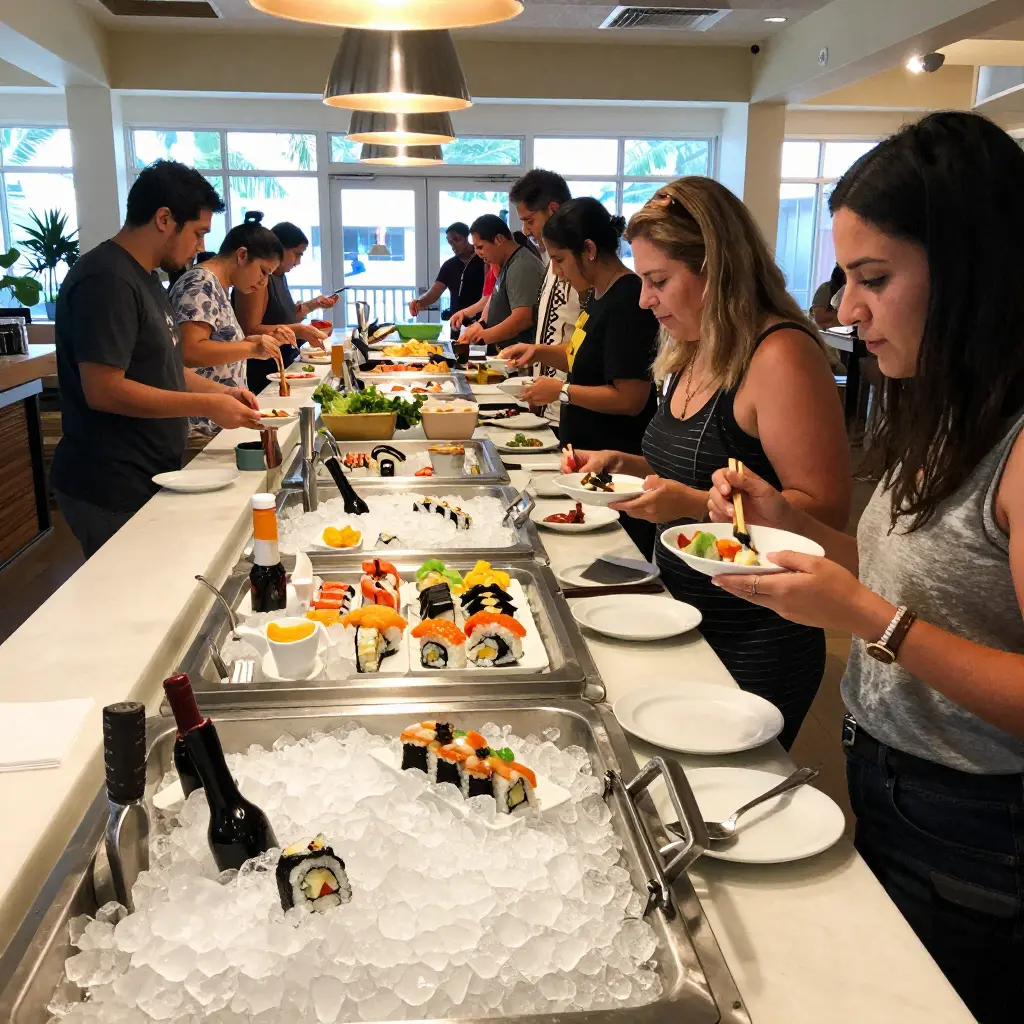
Two Recurring TCS Defects in High-Volume Buffet and Sushi Operations
High-volume Chinese buffet St Augustine and sushi programs tend to fail temperature control in the same two places. Both are time/temperature control for safety (TCS) failures, and both have a cause you can point at: equipment capacity, batch workflow, or the design of the record itself. A defect with a physical cause can be measured and fixed. Retraining the crew usually can’t touch it.
The first is the sushi rice ice bath. Cooked rice sits on the TCS list, acidified or not, unless someone has documented a pH at or below 4.6, and most kitchens haven’t. Cooling has to take it from 135°F to 70°F within two hours and to 41°F within six hours total. Ice baths get sized for a quiet Tuesday. At the 1 p.m. lunch peak on a beach weekend, batch size, batch frequency and pan depth all outrun what the bath can pull; nobody drains and re-ices between batches; pans get nested instead of spread thin. The rice parks in the 50s and 60s, and the six-hour clock runs out first.
The second is the 41F cold hold gap. Walk-ins and display cases hold product above 41°F while air temperature, pans filled past the load line and a defrost cycle hide it. The cold holding log never catches it, because the reading was taken from case air instead of the product core, or copied forward from the previous shift. The paperwork is compliant. The food was never in range.
- Sushi rice ice bath: at the 1 p.m. beach-weekend peak, the bath’s heat-transfer capacity runs out before the cooling schedule does, so the six-hour window closes with the rice still above 41°F.
- 41F cold hold gap: walk-in and display-case product drifts above 41°F while the cold holding log records case air instead of product temperature, which conceals the deviation.
Thermal Mass Beats Ice
Cooked, seasoned rice is a dense thermal mass. Starch gelatinization has already turned its free water into a viscous gel, and gel moves heat slowly compared with the stainless pan underneath it. An ice bath chills the surface film; the core keeps pushing stored heat up into the bed above.
A Deep Bed Insulates Itself
Depth is the variable nobody measures. In a deep rice bed the outer centimeters shield everything beneath them. Rice is mostly water plus trapped air, a poor conductor, so the pan cools from the outside in and then stalls. A shallow, wide pan exposes more surface per pound and gets there faster.
Surface Temperature Is Not Core Temperature
A probe laid on the top layer can read 45°F with the center still near 80°F. Rice that isn’t stirred stratifies, and a surface check signs off on a number the product never held.
Ice Ratio, Meltwater, and Dilution
Capacity in a sushi rice ice bath depends on the ice-to-water ratio, not on how much ice went in. As the ice melts, the slurry drifts toward ambient temperature and loses capacity exactly when the rice load peaks. Meltwater pooling against the pan cuts contact area as well.
Agitation, Pan Geometry, Material
Cooling needs agitation and pan rotation every 10 to 15 minutes. Thin-gauge aluminum and stainless move heat well; a deep plastic pan does not. On a beach weekend the kitchen itself is hot, which slows how quickly the bath recovers between loads.
The Two-Stage Standard
Cool from 135°F to 70°F within 2 hours, then to 41°F within 4 more, six hours total. Miss the first window and the second stops applying: the batch has to be reheated to 165°F and recooled from the start, or discarded.
Why 1 p.m. Is Structural
By 1 p.m. the first batch is stuck on its cooling plateau, the second rice cook is dumping a fresh 150°F mass into the same bath, and the ice has already lost capacity. That overlap is the failure point, not any one person. Before the weekend is when to walk the St. Augustine buffet operations you’re modeling.
Ice Bath Cooling Variables: Peak-Period Failure Modes and Measurable Control Limits
The table below takes the eight variables inside a sushi rice ice bath that drift most often during the 1 p.m. surge and gives each one a number a manager can measure instead of estimate.
| Variable | Typical failure at peak volume | Measurable control limit | Verification method |
|---|---|---|---|
| Rice bed depth | Rice mounded above the pan rim traps a warm core that sits above 41F for hours while the surface reads cold | 1.5 in (38 mm) maximum loose depth; no rice above the pan rim | Steel ruler at 3 random points per pan; probe the deepest point of the bed |
| Ice-to-water ratio | Water added to loosen sticky rice dilutes the slurry, leaving the bath at 40-45F instead of near freezing | 1:1 ice to water by volume; slurry held at 32-34F (0-1C) | Calibrated probe at the pan base; visual check for free ice at the surface |
| Agitation or pan rotation frequency | Pan parked in one spot, so the rice touching the slurry over-chills while the top layer warms | Rotate or agitate every 10 minutes; pan turned 90 degrees at each interval | Timer log initialed by the rice station attendant |
| Batch size per pan | Over-filled pan (above 8 qt cooked rice) cannot reach 41F inside the six-hour window | 6 qt (5.7 L) cooked rice per full-size hotel pan maximum | Scale weight check at pan fill; pan count reconciled per 2-hour window |
| Ambient kitchen temperature | Kitchen passes 90F at peak and radiant load overwhelms the bath | 85F (29C) dry-bulb at the rice station; corrective action at 88F (31C) | Wall thermometer read hourly and logged at 12:00, 13:00, and 14:00 |
| Probe placement point | Probe reads the chilled surface crust or the ice itself instead of the thermal center | Center of the thickest rice mass, inserted to 50% of bed depth, minimum 0.75 in (19 mm) | Calibrated thermocouple with 15-second stabilization; reading recorded per pan |
| Pan material and gauge | Thin 24-gauge aluminum bows away from the ice, opening warm air gaps under the pan | 300-series stainless or 18/8, 22-gauge minimum, 0.030 in (0.76 mm) wall | Caliper gauge check at pan issue and quarterly; confirm the 300-series stamp, since a magnet says nothing about gauge |
| Elapsed time since cook | Rice enters the bath still near 140F and staff assume the ice will catch up | Bath entry within 30 minutes of cook; 70F by the two-hour mark and 41F within six hours of the 135F start point | Cook-log time stamp matched to the probe reading taken at the 2-hour mark |
On a walk-through, treat each row as pass or fail. Measure bed depth and slurry temperature at the pan, check that the rotation and probe entries fall inside the stated intervals, then initial the record on the spot. Drift caught at the station is a correction; drift caught in the office is an incident. For a second reference point, see how St. Augustine buffets manage peak beach-weekend volume.
The 41°F Cold-Hold Gap: Compliant Surfaces, Non-Compliant Cores
The 41F cold hold gap is the distance between a compliant surface reading and the real internal temperature of the same product. The surface sits at or below 41°F while the core of stacked or densely packed product, the back of the pan and the bottom layers of a display case run 43°F to 46°F. Air movement and evaporative cooling keep exposed surfaces cold. The mass underneath sheds heat at its own pace.
Where the gap hides
It forms in the same physical places every time:
| Location | Mechanism | Typical core |
|---|---|---|
| Top layer of a pan | Maximum cold-air exposure | 38-41°F |
| Rear of a reach-in | Warmest return air | 43-46°F |
| Stacked trays | Lower tray insulates the upper | 43-45°F |
| Rice held under nori | The wrap shields the rice from moving air | 44-46°F |
| Deep hotel pans in a crowded cold well | Walls touch, airflow blocked | 43-46°F |
Every row is a spot where a surface probe returns a passing number and the product mass behind it does not.
Measurement error that manufactures compliance
False compliance is usually a measurement artifact rather than a broken compressor. A single probe on the surface samples the coldest boundary available. Probing the coldest item in the case, usually something thin and near the fan, proves the case is running, not that the food is safe. Probing the moment a lid comes off catches the air that just moved, not the product. None of those readings describe the core of the stack, and the core is what the 41F cold hold standard actually regulates.
Regulatory consequence
TCS food above 41°F is out of compliance. It has to be cooled to 41°F inside the prescribed window, held under an approved time-as-a-public-health-control procedure, or discarded within the 4-hour limit. Apart from a documented time-as-a-public-health-control hold, there is no state in which product sits at 44°F and stays compliant. That is why the defensible log entry for high-volume St. Augustine buffet operations comes from the core of a stacked pan, not its surface.
Reading the Ice Bath in Real Numbers
Bed depth, not ice volume, decides whether a batch of sushi rice clears cold hold on a busy beach weekend. The curves below put a 2-inch bed and a 4-inch bed against the same 70°F and 41°F lines, with markers at the 120- and 240-minute points that show up on most cooling logs (the kind of log behind St. Augustine beach-weekend service).

Read the curves by depth. The 2-inch bed crosses 70°F around minute 112 and reaches 41°F near minute 225, which fits the six-hour window with time to spare. The 4-inch bed doesn’t cross 70°F until minute 245 and is still near 60°F at minute 300; it never reaches 41°F. At 1 p.m. beach-weekend volume, only the shallow bed clears. Four-inch batches have to be split or iced harder.
Why the Cold-Holding Log Is Never Completed
An incomplete cold holding log usually gets blamed on the crew. Trace the form itself and a different pattern shows up: it doesn’t describe the operation it monitors, so filling it in accurately during service isn’t possible. What you get is not a recorded failure but an unrecorded gap, and unrecorded gaps disappear in review. A blank cell reads as “nothing to report,” not “no reading taken.”
Five structural defects do most of the damage:
- Field list built from the menu, not the TCS inventory. Sushi rice, cut melon and dairy sauces are missing while non-TCS items hold rows. Fix: derive the fields from the station’s TCS inventory.
- Hourly intervals that land inside the lunch peak. Readings scheduled at 12:00 and 13:00 fall when nobody can leave the line, so they get back-filled or skipped. Fix: anchor intervals to service milestones instead of clock hours.
- One signature covering several items and several hours. A single initial at the bottom of a column cannot document eight containers. Fix: one initial per item at each reading.
- No corrective-action, thermometer-ID or calibration fields. An excursion has nowhere to be resolved and no device to trace it to. Fix: add action, time, verification, device ID and calibration date.
- Half-hour rounding and remote log storage. A 41F cold hold verified at 13:47 is written as 14:00, then re-transcribed from an office binder. Fix: record the actual clock time and keep the log at the station.
Move the log onto a tablet that drops when the kitchen loses connectivity and the same thing happens: entries vanish instead of getting flagged. Reviewers end up measuring completeness rather than excursion frequency, which is how the gap stays unlogged. If you run beach-weekend volume in St. Augustine, start by rebuilding the form around the station it serves.
Visualizing the Flow: Seven Blocks Between the Wok and the Logbook
Most rice failures on a busy beach weekend aren’t mysteries. They’re sequencing failures: the batch gets cooked, then the seven steps that should follow arrive late, out of order, or not at all. The diagram puts the whole cooling and probe-verification flow in one left-to-right line, which makes it easy to see whether a batch skipped a checkpoint or stalled between the ice bath and the walk-in.
The seven blocks are the path a compliant batch takes: cooked rice, transfer to a shallow pan, ice water bath, first temperature checkpoint, second checkpoint, cold hold, hourly probe with log entry. Color marks the stage, so hot, cooling and cold hold each read differently, while the two checkpoint blocks carry an accent color. Those are the only two moments where a thermometer number decides whether the batch continues or is discarded. On a line running flat out at 1 p.m., the accent blocks are where the drift shows first.

The seven control points in the diagram, rice through hourly logging, are what the checklist below turns into signed steps.
Read it the way you’d read a rail map. Every arrow is a handoff, and handoffs are where accountability transfers or leaks. The 41°F gap that goes unlogged usually happens on an arrow rather than inside a block, which is why the sequence matters as much as the written procedure. If you’re checking your own line against this, compare how the procedure is documented at St. Augustine buffet operations where beach-weekend volume concentrates the risk.
The 1 P.M. Sushi Rice Reset Checklist
At 1 p.m. on a beach weekend, the sushi rice ice bath is the last thing standing between a warm batch and the danger zone. Work the list in order.
- Assess the held batch with a calibrated thermometer, and pull any pan reading below 135°F before you start the transfer sequence.
- Transfer rice into shallow hotel pans at a maximum depth of 1.5 inches, spread evenly so no mound rises above that profile.
- Build the sushi rice ice bath at 1:1 ice to water by volume at minimum, 2:1 at peak, with slush surrounding the pan up to the rice line.
- Stir the batch every 5 minutes for 30 minutes, then confirm it drops below 70°F inside that first cooling window before proceeding.
- Keep agitating every 10 minutes until the core reaches 41°F, targeting completion within 6 hours of the cook time on the log.
- Probe the thickest geometric center of the deepest pan, with the stem at the middle of the bed and at least 0.75 inch deep, holding until the reading stabilizes.
- Record the final temperature, time and thermometer ID in the cold holding log, and flag any reading still above 41°F at that check.
- Sign off the reset and authorize immediate discard of any batch still above 41°F when the six-hour window closes, documenting the decision and batch weight.
Log the misses. On inspection day, an undocumented ice bath looks exactly like a failed one, and operators tightening this habit can review our St. Augustine Chinese buffet operating notes.
Root-Cause Analysis: Proximate Symptoms versus System Defects
Root-cause analysis separates what failed from why. Both defects here run through the 5 Whys, and every link in each chain is something you can observe.
Applied to the 1 p.m. cooling failure, the chain runs: the rice bed is warm → cooling time exceeded the two-stage limit → the sushi rice ice bath was loaded beyond its heat-transfer capacity → batch size was set by pan count, not by cooling throughput → no documented capacity standard governed batch sizing.
Applied to the unlogged 41F cold hold gap, the chain runs: no entry exists → no signature marks verification → corrective action was never triggered → the log has no corrective-action field → the form was designed as a record, not a control.
The distinction earns its keep. A warm rice bed is the proximate cause; batch sizing that outruns cooling capacity is the system cause. A missing signature is proximate; a log with no corrective-action field is the system cause. Fix only the proximate and the failure returns next Saturday.
Six categories cover most of it on the line:
- Method: does the written procedure name the cooling intervals, load limits and verification steps?
- Equipment and thermometers: are units calibrated, big enough for the load, and ready to probe?
- Material and batch sizing: does each batch match documented cooling throughput?
- Measurement: are readings taken at the core of the thickest portion?
- People and scheduling: does staffing match the 1 p.m. peak?
- Environment and ambient load: is ambient heat raising the load on the line?
Documented controls hold up under inspection; corrected symptoms don’t. These compliance references for St. Augustine buffet operations cover the paperwork side.
Where Cooling and Cold-Hold Failures Originate
Before you add one more server on a Saturday, look at where the risk actually piles up. In high-volume buffet kitchens, cooling and cold-hold failures cluster in a handful of predictable places, and the largest clusters are planning and paperwork rather than people.

The two largest segments are batch sizing and cooling capacity (32%) and documentation and log design (27%). Together they account for nearly six in ten failures, and neither improves by adding staff hours. Reroute the rice ice-bath schedule, size batches to the cooling capacity you actually have, and rebuild the 41F log so a missed reading is obvious on sight. Fix the system, not the shift.
Reading the Distribution in Practice
| Root cause | Share | Primary control lever |
|---|---|---|
| Batch sizing and cooling capacity | 32% | Shift batch volume and split the ice bath into staged, shallow pans |
| Documentation and log design | 27% | Redesign the form so blank cells and out-of-range values are self-evident |
| Thermometer calibration and probe technique | 19% | Daily ice-point checks and probe-the-center practice |
| Procedure and training gaps | 14% | Written SOPs with a short seasonal refresher |
| Cold-hold equipment and case layout | 8% | Case load lines, airflow clearance, and repair tickets |
Most of the failure mass sits upstream of the line cook, in how the batch was sized and how the sheet they sign was designed. Anyone who has reviewed St. Augustine high-volume buffet operations will recognize the pattern: the log takes the blame, but the schedule created the missing margin.
One Written Procedure, Two Defects
The failed ice bath and the unlogged 41F gap need one page between them: the same hold-or-discard test, the same re-check window, the same audit trail. Post it at the station rather than filing it in a binder.

Hold, Re-Cool, or Discard
- Re-cool – product above 41°F but less than four hours out of temperature and still below 70°F: ice bath or blast chiller, then re-probe.
- Time as a public health control – product between 41°F and 135°F with no documented start time: mark a four-hour discard time, hold, then discard.
- Discard – unknown time, over four hours, or failed re-cooling: discard and weigh.
The Re-Check Interval
Re-probe the same container 30 minutes after the corrective action, then again before it goes back on the line. If it hasn’t reached 41°F within four hours of the breach, discard it. Re-icing a warm pan is not a fix.
What the Corrective Action Field Must Show
Record the detection time, product and batch, probe temperature, minutes out of temperature, the action taken, the re-check temperature and time, initials, and disposal weight. “Re-iced” alone fails an audit, because a reviewer has to be able to rebuild the whole event from that line.
Calibration and the Ice-Point Method
Do an ice-point check daily before the 11 a.m. rush and after any drop: stir crushed ice and water, insert the probe, confirm 32°F, adjust, and log it. Five degrees of drift is the difference between a compliant 41F cold hold and a violation.
Sign-Off, Retention, and Live Verification
When the manager is off the floor, the certified person in charge on duty signs the corrective action with full name and title. Keep the cold holding log at least 90 days; six months is safer.
Once a quarter, walk the procedure against a live 1 p.m. batch: time the ice bath, re-probe, compare against the log. Paper-only drills hide the gap that beach Saturdays expose; see our St. Augustine service notes.
41F Cold Hold Log: Required Fields and Purpose
A temperature log with no corrective-action field records what happened to the food but not what anyone did about it. Inspectors read that missing column as the line between monitoring and control, and it’s the point where a 41F cold hold gap turns from a managed risk into an undocumented one.
A complete 41F cold hold log carries nine fields, each doing a specific job. Drop any one and the record stops proving control; it only proves that somebody owned a thermometer.
| Field | What it proves | Required format | Who completes it |
|---|---|---|---|
| Timestamp of reading | The exact time the product was probed, tying the number to a service period such as the 1:00 p.m. beach-weekend rush | 24-hour clock with date (e.g., 07/13 – 13:04) | Person performing the check |
| TCS item and batch identifier | Which time/temperature control for safety food was measured and which production batch it came from | Item name plus batch or prep code (e.g., “sushi rice, batch 0713-B”) | Prep cook or sushi station lead |
| Pan depth and case position | That the food was held at an approved depth and at a known shelf and slot in the display case | Depth in inches plus shelf/slot (e.g., “2 in – shelf 2, slot 4”) | Station attendant |
| Probe location on the product | That the reading came from the coldest, thickest part of the food, not the surface or the pan edge | Short text description (e.g., “center of rice mass, 1 in from base”) | Person performing the check |
| Temperature reading in °F | The measured value against the 41F limit, recorded without rounding down | Whole or one-decimal degrees Fahrenheit (e.g., 43.5 °F) | Person performing the check |
| Thermometer ID and last calibration date | That the instrument producing the number is identified and still inside its calibration interval | Unit serial or tag number plus calibration date | Person performing the check |
| Corrective action taken | What the operator decided to do once the reading exceeded 41F: re-ice, discard, or move to a time-limited hold | Pre-coded action plus short note (e.g., “CA-2, re-iced 25 lb”) | Shift manager / person in charge |
| Re-check reading and time | That the corrective action actually worked and how long the product sat out of range | °F reading plus 24-hour time (e.g., “39.0 °F – 13:22”) | Shift manager / person in charge |
| Manager verification signature | That a person in charge reviewed the entry the same day and owns the record | Printed name, initials, or signature plus review date | Manager on duty |
The same nine fields work unchanged for the sushi rice ice bath record. An ice bath is a cold hold in a different vessel, and it fails the same way when nobody writes down the re-check. Keep both logs in one binder, as St. Augustine buffet teams do, and a single 1:00 p.m. excursion can be traced from probe to corrective action in seconds.
Verification and Inspection Readiness
Calibration gets documented, not assumed. Each thermometer carries a unique ID, a written calibration schedule, and a recorded ice-point result (32°F ± 2°F) that is dated and initialed; any unit outside tolerance comes out of service and gets replaced before the next shift. Cold-hold equipment is mapped rather than improvised, with shelf position, load line and door-zone probe points specified per unit. That removes the guesswork which lets a 1 p.m. beach-weekend rush produce an unlogged 41°F gap. Operators serving St. Augustine beach-weekend volume know the timing pressure well.
Managers spot-recheck staff probe technique against those mapped points at defined intervals and after each new hire. Completed logs follow a set review cadence: shift lead daily, person-in-charge weekly, with signature and date. The 41°F threshold is stricter than jurisdictions that permit limited variance above it; recent state-level operational notes show how widely those allowances vary. Using 41°F as the internal standard absorbs probe drift, ambient error and human timing, so excursions surface before they become reportable. Temperature control and time as a public health control are separate strategies, one bounding product temperature continuously and the other bounding duration against a documented baseline, and every log has to state which is in force.
Inspectors read records looking for decisions, not just numbers. Three things tell them the system works: a corrective action written beside every excursion instead of a blank margin; entries that run continuously across shifts, each dated and initialed; and calibration records that tie every reading to a verified instrument.
Frequently Asked Questions: Cooling, Cold Holding, and Documentation

How quickly must sushi rice be cooled from cook to cold hold?
Two stages: 135°F down to 70°F within 2 hours, then to 41°F within 4 more, 6 hours total. The clock starts when the batch drops below 135°F, in practice when it comes off the cooker, not at 1 p.m. when someone finally builds the sushi rice ice bath.
Is an ice bath mandatory, or will a blast chiller or shallow-pan air cooling satisfy the standard?
No. The code is method-agnostic; it cares about the readings. Blast chillers and shallow pans under 2 inches deep with airflow both pass if logs show 70°F within 2 hours and 41°F within 6. Choose the method your crew can actually run at peak volume.
Is 41°F a fixed national limit for cold holding?
Effectively, yes. The FDA Food Code sets 41°F, and Florida has adopted it, so the 41F cold hold limit is enforceable statewide. A handful of jurisdictions still allow 45°F for select foods, but never assume that. Confirm the exact figure with your local health authority.

What should be done when a cold holding log shows a multi-hour gap in entries?
A gap means unverified, not automatically unsafe. Probe the rice, reconstruct the timeline from cook times and sales data, then discard anything with more than 4 hours unaccounted for. Document the finding and the corrective action on the cold holding log. Many Chinese buffet St Augustine kitchens now require hourly initials.
How often must probe thermometers be calibrated, and how is it documented?
Calibrate daily before the first reading, after any drop, and whenever a result looks wrong. Use an ice-point check: 32°F in an ice-water slurry. Record the date, method, correction made and your initials on the sheet, and hold thermometers to ±2°F accuracy.
Can time as a public health control replace temperature logging for sushi rice on high-volume weekends?
Only with written procedures, time marks and a discard schedule. Rice removed from temperature control must be sold or discarded within 4 hours. Starting at or below 41°F extends that to 6 hours, capped at 70°F. Inspectors still expect the log.
The Operator’s Summary: Two Problems, Four Controls
Both failures come back to design. The 1 p.m. ice bath collapse is a capacity and procedure problem: the batch exceeds what one bath can pull down inside the cooling window, and nobody defined the split point. The 41F cold hold gap is a measurement and documentation problem: the probe reads the wrong part of the product, and the log has no field for what was done about a high reading.
Four control points, in order:
- Batch capacity – cap rice mass per bath at a verified poundage and post that number at the station.
- Two-stage cooling with recorded checkpoints – log time-in and time-at-temperature at both stages, not only at the end.
- Defined probe location – the geometric center of the densest mass, never the surface or pan wall.
- Auditable corrective-action entry – every out-of-range reading carries a written disposition, an owner and a timestamp.
Load profiles differ by store. The Chinese buffet St Augustine beach-weekend surge needs different batch math than a weekday suburban line, and operators managing comparable Jacksonville service volumes tend to find the same four gaps on a different clock.
The durable fix is per-shift verification: a short, signed check at open, mid-service and close that confirms batch size, bath capacity, probe placement and log completion before the next rush starts.
The standard is easy to state. No rice bath larger than its verified capacity, no cooling stage without a recorded temperature, no probe reading without a location, and no out-of-range number without a written response.